

What Size Socks Do I Need? An Australian Guide
Measure the length of your foot in centimetres and match it to the foot length on the label. That one number is the one sock measurement that needs no converting, and where a brand publishes it, it means what any other brand's means.
Everything else — AU, EU, US, "one size", "women's 5–9" — is a translation of that number, and the translations disagree. We know because we audited our own. Across 187 women's styles in the TipSoxx range, the identical 22–26 cm foot length is printed under three different EU ranges, and as both "AU 5–9" and "US 5–9" — which are not the same scale.
What size socks do I need?
You need the sock whose stated foot length covers your foot length. In practice that means three steps:
- Measure your foot. Heel to longest toe, standing, in centimetres.
- Find the foot length on the product page. It is usually written as a range, like 22–26 cm.
- Check that your number sits inside that range, and preferably not right at the top of it.
If a listing gives you only a shoe-size range and no centimetres, you are being asked to trust a conversion the brand has not shown you. That is fine for a $6 pair. It is worth a second look for a $30 one.
| What the label gives you | How reliable it is | What to do |
|---|---|---|
| Foot length in cm | The measurement itself. Same meaning everywhere | Use this |
| EU size range | A conversion, and brands convert differently | Cross-check against cm if you can |
| US size range | A conversion, and brands convert differently | Cross-check against cm |
| AU size range | Rarely printed on our own listings; 39 of 187 | Useful when present |
| "One size" | Not a size. It means the knit stretches across a range the brand should state | Find the range; if none is published, treat it as unspecified |
How do you measure your foot for sock size?
Stand on a sheet of paper with your heel against a wall, mark the paper at the tip of your longest toe, and measure from the wall to the mark. That length in centimetres is your number.
Three things people get wrong:
Measure standing, not sitting. A foot spreads under your body weight, so the standing measurement is the longer one. The sock has to fit the foot you actually walk on.
Measure the longer foot. Most people have one. Measure both once, then use the bigger number from then on.
Measure at the end of the day. Feet are commonly reported to swell over the course of a day, and more so in heat, which in an Australian summer is worth allowing for. Measuring your foot at its largest is the safer error.
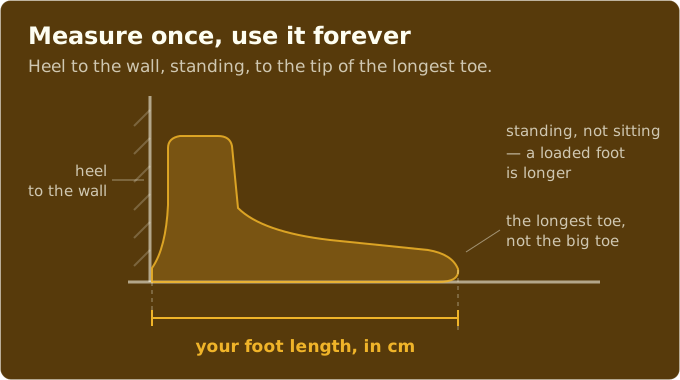
The measuring method. An illustration of the technique, not a scale drawing.
Once you have that number, write it down. It turns every future sock purchase into a two-second check — though it is worth re-measuring every few years rather than assuming it is fixed for life.
What is my sock size in Australia?
There is no Australian sock size, and on our own site most socks do not carry an AU number at all. We have not audited other retailers, so take the rest of this section as a fact about our listings rather than about the Australian market.
Of 187 women's styles in the TipSoxx range, 39 print an AU range and 148 do not. The 148 give you EU, US, a foot length in centimetres, or some combination — but not the number an Australian shopper thinks in.
The practical upshot either way: on a sock listing, the centimetre figure is more likely to be there than an AU size, and it is the more useful of the two.
AU and UK women's shoe sizes share a scale, and US women's numbers are published higher. Which makes the next section awkward for us.
Why does the same sock carry different size labels?
Because the conversion from foot length to a shoe-size range is a judgement, not a standard, and different suppliers make it differently. We can show this happening inside a single brand's range — ours.
Across our own women's styles, 152 state a foot length of 22–26 cm. Here is what those same 152 socks call that span:
| Label printed on a 22–26 cm sock | Styles |
|---|---|
| EU 36–40 | 117 |
| EU 35–40 | 32 |
| EU 36–41 | 3 |
| US 5–9 | 81 |
| US 5–8.5 | 19 |
| AU 5–9 | 39 |
| neither a US nor an AU figure | 13 |
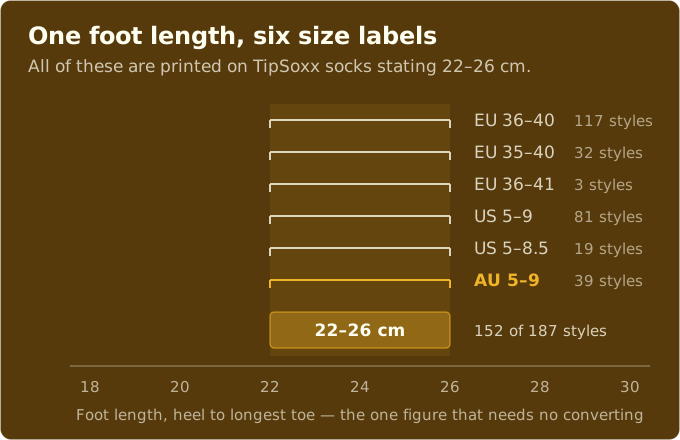
Size labels printed on TipSoxx women's styles that all state the same 22–26 cm foot length. The EU rows account for all 152; the US and AU rows overlap them. Read from TipSoxx product pages on 16 September 2026.
The three EU rows cover all 152 between them, so every one of those socks has a stated foot length and an EU range. Two things go wrong.
The EU bottom edge moves by a full size. A shopper at EU 35 is told by 32 of our listings that the sock fits and by 117 that it does not, for socks with an identical stated foot length.
The same numbers appear on two different scales. These are two real size lines from two of our own product pages:
Size: One Size | Women's AU 5–9 | EU 36–40 | Foot Length 22–26 cm
Size: Women's One Size Fits US 5–9 / EU 36–40 Foot length: 22–26 cm
Same EU range. Same foot length. Same numbers, 5 to 9 — on two scales that are not interchangeable. No product in our catalogue prints both, so nothing on either page tells you which one to trust.
We are not defending this. It is a data-quality problem on our own listings and we are fixing it. We are publishing it because it is the clearest demonstration we have of the actual advice: read the centimetres, not the size name.
Is sock size the same as shoe size?
Sock size is not the same as shoe size, and treating them as equivalent is where most sizing confusion starts.
A shoe size describes the last a shoe is built around, and a shoe has room in it your foot does not fill. A sock size describes how far a piece of knitted fabric will stretch, with nothing spare. Two socks marked for the same shoe size can stretch across quite different spans depending on the yarn, the rib, and how much elastane is in the cuff. Composition matters here, and what makes a sock good for daily wear covers how to read it.
Height changes the answer too. A crew sock has to stretch over your calf as well as your foot, so a crew and an ankle sock with the same stated foot length can fit differently on the same person. Sock lengths for women works through which height suits which shoe.
What size are TipSoxx socks?
Most TipSoxx socks are one size, built to a stated foot length. These are every band the range uses, read from our product pages:
| Range | Foot length | Most common EU label | Styles |
|---|---|---|---|
| Women's, main band | 22–26 cm | EU 36–40 (117 of 152) | 152 of 187 |
| Women's, slightly shorter | 23–26 cm | EU 36–40 (12 of 13) | 13 of 187 |
| Women's, narrow | 22–24 cm | EU 35–39 (8 of 10) | 10 of 187 |
| Women's, narrowest | 21–24 cm | EU 35–38 (3 of 3) | 3 of 187 |
| Women's, widest | 22–28 cm | EU 35–44 (2 of 2) | 2 of 187 |
| Women's, no foot length stated | — | — | 7 of 187 |
| Men's and unisex | 24–29 cm across four bands | EU 40–44 or 41–44 | 26 |
| Kids' | 14–22 cm across four bands | EU 25–29 and 28–34 | 12 of 15 |
The last two rows are deliberately coarse, because those two groups spread across four foot-length bands each and seven of the men's and unisex listings print no EU figure at all. Three of our baby styles are sold in lettered sizes rather than a single range, so they are not in that kids' count.
The seven women's styles with no foot length are four leg warmers, where a foot length is not the right measurement; one crew style that publishes no size information of any kind; and our two no-show styles, which give EU 35–38 and nothing else.
How we counted. A style is women's if a product tag or its title says so, and is excluded if it carries a men's, unisex, kids' or baby label. Duplicate listings are counted once. Where a listing prints a scale more than once, we took the first. The individual product page is the source, not this table — size blocks change, and the EU column is the most common label at that foot length, not the only one, for the reason the previous section explains.
If your foot is 26 cm, you are at the top edge of the women's main band, and inside all four of the men's and unisex bands — though at the bottom edge of the largest of them, which covers 13 of the 26 styles. In that case a men's or unisex sock is worth trying even if the label is not the one you wanted, because a sock held at the top of its stated range has no give left in it.
How do you choose a sock size for someone else?
Use their shoe size, accept that you are working from a conversion, and choose a style whose stated range is wide rather than narrow. A 22–26 cm sock forgives a guess; a 22–24 cm one does not.
Socks in the middle of a wide band are the safest gift, which is a point are socks a good gift makes in more detail. If you genuinely do not know their size, a crew sock in a one-size band is more forgiving than an ankle sock, because more of the fit is happening on the leg rather than the foot.
Questions we get asked
What size socks do I need?
Measure your foot from heel to longest toe in centimetres while standing, then choose a sock whose stated foot length covers that number. Most of our adult women's socks are built around a 22–26 cm band.
Is my sock size the same as my shoe size?
No. A shoe size describes the shoe's last and includes room your foot does not fill; a sock size describes how far the knit stretches. Use foot length in centimetres where the brand publishes it.
What is my sock size in Australia?
There is no separate Australian sock scale. Of our own 187 women's styles, only 39 print an AU range; the rest give EU, US or a foot length in centimetres. Our own listings put the numbers 5–9 on an AU label and on a US label for socks with an identical stated foot length, which is why the centimetre figure is the one to trust.
What does "one size" actually mean on a sock?
It means the knit stretches across a stated range, not that it fits everyone. Find the range. If the listing does not publish one, treat "one size" as unspecified rather than universal.
Why do two socks marked the same size fit differently?
Because the size name is a conversion from foot length, and brands convert differently — we found three different EU labels on our own socks that all state the same 22–26 cm. Knit structure and elastane content also change how far a sock gives.
My feet are between two sizes. Which way should I go?
Go up. A sock held at the top of its stated range has no give left, while a slightly roomy sock mostly just feels slightly roomy. That is our buying rule rather than a tested finding.
Related guides: for what the sock is made of rather than how big it is, start with what makes a sock good for daily wear. For height rather than size, see sock lengths for women. If a sock that fit has stopped fitting, do socks shrink in the dryer covers what is actually happening.
Shop by size band: women's crew socks, women's ankle socks and women's cute everyday socks.
Published 16 September 2026 by the TipSoxx team, Australia. Size figures are read from TipSoxx product pages on that date and may change; the individual product page is always the current source.
Reviewed by: Chelsea Ding