

What Makes a Sock Good for Daily Wear?
Four things decide whether a sock is still comfortable at the end of a long day: what it is made of, how much stretch fibre holds it up, how the toe is closed, and whether the height suits the shoe. All four are printed on the product page. The picture on the sock is not one of them.
The picture is the part people worry about most, so we went and checked. We read the published compositions across our own women's range — 178 styles, 153 of which publish a cotton figure — and compared the ones with a picture on them against the ones without. The gap between those two groups is small, and it moves depending on where you draw the line. The gap between two socks that look alike does not move at all.
What makes a sock good for daily wear?
A sock earns all-day wear on four properties, and each one is checkable on a product page before you buy.
| What to check | What it changes | What to look for |
|---|---|---|
| Fibre composition | Breathability, softness, how it handles sweat | A stated percentage, not an adjective. "Cotton-rich" is not a number |
| Elastane share | Whether it stays up, and how hard the cuff grips | Roughly 2–5% is the everyday band. 135 of the 161 women's styles in our range that publish a figure sit inside it, median 3% |
| Toe construction | Whether a seam rubs across your toes inside a shoe | "Flat", "linked" or "hand-linked" tells you something. "Seamless comfort" alone does not |
| Height vs your shoe | Whether the cuff clears the shoe edge, which is where rubbing starts | Match the height to the shoe, not to the outfit |
That is the order we buy to. Composition sets what the sock can be; the other three decide whether it gets there on your foot.
Are fashion socks comfortable for everyday wear?
Fashion socks are made much the same way as plain ones in our range, so there is no reason to expect them to be less comfortable. Here is the check, and its limits.
Nothing in our product data labels a sock "patterned", so we drew the line ourselves, from product titles, and we drew it twice. The strict version counts only titles naming a literal motif — a cat, a cherry, a stripe. The loose version also counts our evocatively named art-print series, where the title is a mood rather than a description. The two disagree about 22 styles. A ruffle, a lace cuff or a bow counts as no motif in both: it is texture, not a picture.
| Strict line | Loose line | |
|---|---|---|
| Styles with a motif | 102 | 124 |
| Styles without one | 51 | 29 |
| Cotton median, with motif | 82.9% | 82.9% |
| Cotton median, without | 82.5% | 80.0% |
| Gap between medians | 0.4 points | 2.9 points |
| Cotton range, with motif | 20–100% | 20–100% |
| Cotton range, without | 20–87% | 40–87% |
| Elastane median, all four groups | 3% | 3% |
Moving 22 styles between the groups moves the gap from 0.4 points to 2.9, so we are not going to tell you the two groups are identical — a result that swings that far on a line we drew by hand has not earned that. What both versions agree on is the shape: the elastane median is 3% in all four groups, and the gap between groups stays small next to the 47 to 80 points of cotton spread inside each one.
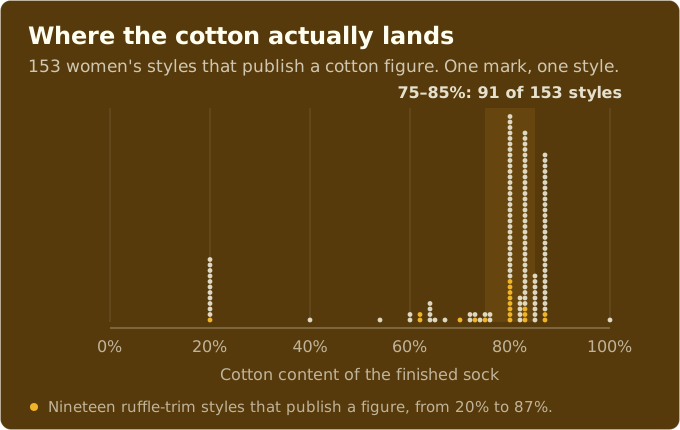
Every women's style in the TipSoxx range that publishes a cotton figure, read from TipSoxx product pages on 16 September 2026. Each mark is one style. Illustration built from those published figures, not a laboratory measurement.
The scatter is the finding. Of 153 styles publishing a cotton figure, 91 sit between 75% and 85%, 30 sit below and 32 above; the median is 82.5%. Now take one look and follow it across. We sell twenty ruffle-trim styles; the nineteen that publish a figure run from 20% cotton to 87% cotton. Same trim, nearly the whole range. Choosing by the trim tells you nothing about what is against your foot. (That category comes from product titles too, the same way the motif line does.)
Correction, 16 September 2026: an earlier version of this guide said our socks typically contain 75–85% cotton. Read against the women's range as it stands today, that band covers 91 of 153 styles — 59%, which is a majority rather than a typical case — with 30 below it and 32 above. We have replaced it with the spread shown here.
Three limits on all of this, at the point they apply. These are published compositions, not measurements we have taken. A percentage is not a comfort test, so what the numbers support is a claim about how the socks are made, not about how any one of them feels. And the motif line is our own editorial label rather than anything in our product data, which is why we have shown you both versions of it and what moves when it moves.
Where the picture on the sock does change something is the workplace, and that is a question about how the sock reads rather than how it feels: can you wear fun socks to work covers motif scale and colour strength.
What is the best sock material for everyday wear?
For most Australian days, a cotton-rich blend with a small amount of stretch fibre and something for durability is the useful default. What each fibre is doing:
- Cotton absorbs moisture and feels soft against skin. It is the base of most of our everyday range, and the reason the median style sits at 82.5% cotton.
- Polyester, nylon and recycled fibres are added for abrasion resistance and shape retention. That is the job they are there to do, and it is why exactly one style in our women's range is cotton alone.
- Elastane, spandex or Lycra at a few percent is what holds the sock up. It is also the fibre that a hot dryer destroys, which is covered in do socks shrink in the dryer.
- Modal and viscose drape softer and cooler than cotton but absorb differently. Several of our styles are viscose-led rather than cotton-led.
- Merino wool buffers temperature swings better than cotton. How much merino is actually in a "merino wool blend" runs from 16% to 60% across the eight styles in our range that state it, which is a separate question with its own answer: what the blend percentage means.
We have not run comparative wear or moisture testing on these socks. The descriptions above are what each fibre does structurally, which is different from a tested performance claim, and we would rather say so than imply a lab result we do not have.
What are comfortable socks you can wear from morning to night?
A sock that is still comfortable at the end of a long day is usually one that got three contact points right, because those are the three places a sock can annoy you.
The cuff. Elastic has to grip to hold the sock up, and grip leaves a mark. A crew cuff sits on a wider part of the leg than an ankle cuff does, so a given cuff tension is spread over more of you. If your socks leave a ring, the mechanism is explained in why socks leave marks on your legs.
The toe. Where a sock is closed at the toe, there is a join, and a raised one sits across the top of your toes inside the shoe. It is the contact point people most often report as the one that annoys them. In our experience most socks sold as seamless still have a join, just a flatter one — seamless toe socks: who actually needs them explains how to tell.
The shoe edge. Every shoe has a rim that sits against your leg or foot: the shaft on a boot, the collar on a sneaker, the topline on a flat. A sock that stops just short of that rim leaves your skin against it instead.
Which sock styles are best for everyday wear?
Crew, quarter and ankle each suit a different shoe, and the shoe should pick the height rather than the other way round.
- Crew sits on the mid lower leg. It suits ankle boots and chunky sneakers, where a shorter sock would end inside the shaft and rub. Our women's crew socks are the bulk of the everyday range.
- Quarter sits above the ankle bone — roughly a hand's width up, though brands are not consistent about it and we have not measured our own range. It clears a low-top sneaker collar while still leaving some leg visible with cropped trousers. These sit in women's cute everyday socks.
- Ankle clears the ankle bone and little more, which suits warmer days and low-cut shoes. See women's ankle socks.
Height is a bigger decision than it looks, and sock lengths for women works through which height clears which shoe. With a dress or skirt the sock becomes part of the outfit rather than an invisible layer, which changes the calculation: what socks to wear with a dress.
How do you choose the right socks for daily use?
Read the composition first, then the height, then the toe. In practice that is four checks on a product page:
- Find a number for the main fibre. If the listing only says "premium cotton blend" with no percentage, you are being told a category, not a product.
- Check the elastane. Two to five percent is the everyday band, and that is where 135 of our 161 women's styles land, with a median of 3%. It is the band we buy to rather than a tested threshold. Twenty of ours sit below it; five of the six that sit above it carry a ruffle or lace cuff, and the sixth is a wool-blend knit.
- Check the toe wording. Construction words beat comfort words.
- Match the height to the shoe you will actually wear them with.
If a sock fits badly rather than feels wrong, why socks don't fit maps each fit problem to its guide. If it wears out too soon, start with how to make socks last longer.
If you are buying for someone else, the same four checks apply and the sizing is the harder part — are socks a good gift covers when they land well and when they do not.
Questions we get asked
Are cotton socks good for everyday wear?
Cotton socks suit everyday wear because cotton absorbs moisture and feels soft against skin. Almost all of them are blended rather than pure cotton, because the other fibres are what carry stretch and abrasion resistance: across our own women's range, exactly one style of 153 is cotton alone.
Why do socks need polyester or nylon?
Polyester, nylon and recycled fibres are added for abrasion resistance and shape retention. That is the role they are specified for in a blend; cotton is there for feel and moisture.
How much elastane should an everyday sock have?
Roughly two to five percent for everyday wear. Across our own women's range, 135 of the 161 styles that publish a figure sit in that band and the median is three percent. This is the band we buy to, not a tested threshold.
Does a patterned sock wear out faster than a plain one?
Not from the pattern itself. Durability follows the composition and the knit. Across our own range, styles with a motif and styles without carry the same median elastane, and their cotton medians are 0.4 points apart on one reading of which is which and 2.9 on another — which is why we publish both.
Is combed cotton worth paying for?
Combing is a real processing step rather than a marketing word: the shorter fibres are removed before spinning, which is what the smoother surface is attributed to. We have not run pilling or wear tests, so we cannot tell you what that is worth to you against the overall composition.
Published 29 December 2025 by the TipSoxx team, Australia. Revised 16 September 2026. The figures here come from a single source: the fibre compositions published on TipSoxx product pages, read on 16 September 2026.
Reviewed by: Jinwen Ding