

Do Socks Shrink in the Dryer? What Is Actually Happening
Cotton socks do shrink in a dryer, and the amount depends on how the fabric was processed before you ever bought it rather than on how hot you wash it. That is the short answer, and it is also incomplete, because most socks people describe as shrunk have not shrunk at all.
Three different things go wrong in a dryer and they feel similar on the foot. The sock got smaller, the elastic gave up, or the wool felted. Each has a different cause, a different fix, and only one of them is actually shrinkage.
Which of the three failures do you have
Work out which failure you have before changing anything about your laundry, because the fix for one makes another worse.
| What you notice | What happened | Reversible |
|---|---|---|
| Tight across the foot, shorter than it was, fabric still stretchy | Cotton shrinkage. The knit loops have relaxed back toward their unstretched shape | Partly. Stretching while damp recovers some length |
| Slides down, cuff no longer grips, sock looks the same size | Elastane heat damage. The stretch fibre has lost recovery | No |
| Thicker, stiffer, denser, noticeably smaller | Wool felting. The fibre scales have locked together | No |
| Trim creased, frill gone flat, sock otherwise fine | Heat damage to a decorative band, usually from ironing | No |
The second row is the one people misread most often. A sock that will not stay up has not shrunk; it has gone loose, which is the opposite. Turning down the wash temperature will not bring it back, and neither will anything else.
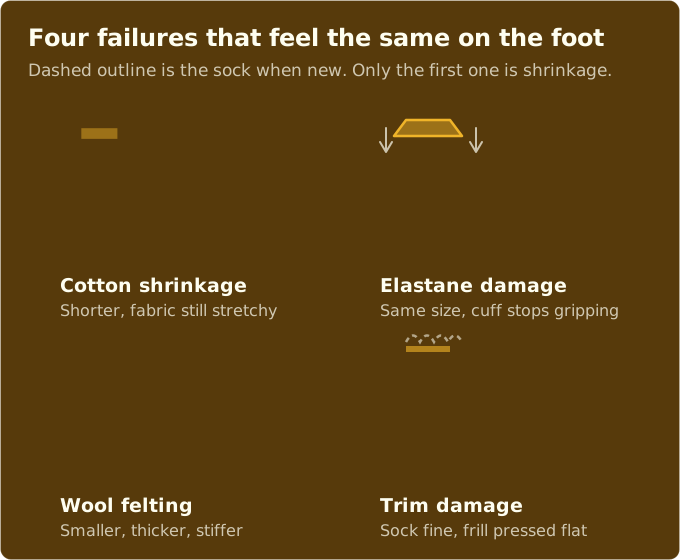
The four failures described above, drawn to show how each changes the sock. An illustration of the categories rather than measured results.
How much do cotton socks actually shrink
Cotton socks shrink most in the first wash and dry, then very little afterwards. Cotton Incorporated, whose technical bulletin on shrinkage performance tested cotton knits through repeated home laundering, reports that "one cycle may remove around 90% of the total shrinkage available". A sock that still fits after its first wash and dry will usually keep fitting.
TipSoxx has not run measured shrinkage tests on its own socks, so there is no TipSoxx figure to put against that industry one. What our compositions do show is which of our socks are exposed to it: the cotton-rich everyday styles sit between 62% and 87% cotton, and those are the ones with something to shrink. A viscose-led sock at around 81% viscose behaves differently and is more likely to be damaged by heat than shortened by it.
The counter-intuitive part is that wash temperature is not the lever most people think it is. Cotton Incorporated's testing found "the shrinkage curves and total shrinkage values were identical for all three temperatures commonly encountered in home laundering". What drives it instead is water plus movement: the same bulletin describes absorbed water acting "as a lubricant", so that "the application of energy in the form of mechanical action (a dynamic force) upon the fabric will result in even higher levels of shrinkage".
So the amount of shrinkage available in a sock is set at the mill, by how much the fabric was stretched during processing, and you cannot tell from the outside which socks have more of it left. What you control at home is how much mechanical action you put through it.
Why elastane is the fibre that actually decides this
Elastane content, not cotton content, is what determines whether a dryer ruins a sock. It is the fibre that holds the cuff up and returns the sock to shape, and it is the one that heat degrades permanently.
Across the TipSoxx range that share runs from 0.9% to 8.3%, read from our product pages on 8 September 2026. A quarter sock at 0.9% has very little to lose. A crew sock at 8.3% is carrying its own weight up your leg on that fibre, and when it goes the sock is finished even though the cotton is untouched.
The practical version: the socks that most need to stay up are the ones a dryer damages fastest. That is the opposite of how most people sort their laundry, because those are usually the socks worn most.

Why care labels differ between socks from the same brand
Care labels differ within one brand because construction differs, not because the labels are inconsistent. The TipSoxx range carries at least four different instructions, and each corresponds to something real:
- Machine wash cold, tumble dry low. Cotton-rich socks with no separate trim and moderate elastane. There is little to damage.
- Cold gentle wash, do not tumble dry, line dry in the shade. Viscose and modal blends, and anything with a lace or sheer band. Both the fibre and the trim are heat-sensitive.
- Machine wash at 40°C, do not tumble dry. Cotton styles where the wash temperature is fine but the dryer is not.
- Machine wash at 30°C, do not tumble dry, lay flat to dry. The wool blends. Wet wool stretches under its own weight, so flat drying is doing a different job from shade drying.
Reading the label on the sock in your hand beats any general rule, including this article. Where a brand publishes no instruction at all, treat the sock as though it were in the second group.
What the dryer does that line drying does not
A dryer applies sustained heat and continuous mechanical agitation at the same time, and those two do different jobs of damage. The agitation is what drives cotton shrinkage; the heat is what degrades elastane and felts wool. Air drying removes both at once, which is why it is the single change that helps most.
There is an Australian complication that northern-hemisphere laundry advice does not cover. Line drying here is the default rather than the fallback, and direct summer sun is hard on colour: cream, pastel and dyed trims fade noticeably faster in full sun than in shade. This is why TipSoxx care labels specify shade rather than just line drying. Drying flat in the shade indoors is the safest option for anything with wool or a decorative band.
If you use a dryer anyway, take the socks out while they are still slightly damp and let them finish on a rack. That cuts both the tumbling time and the final stretch of the cycle, which is when the load is driest and the fabric temperature is highest.
Can you unshrink a sock
A cotton sock that has shrunk can be partly recovered by soaking it in cool water, then stretching it gently by hand while damp and drying it flat in that shape. Some length comes back. It will not be the sock it was.
Nothing recovers a sock whose elastane has been heat-damaged, and nothing recovers felted wool. Both changes are permanent at the fibre level. If a sock has gone loose or gone hard rather than short, the honest answer is that it is finished.

How to make socks last
Wash cool, skip the dryer for anything with wool, lace or a high elastane share, and dry in the shade. That covers most of the difference between socks that last a year and socks that last three.
Four habits worth the effort:
Wash inside out. The inside of the sock takes the wear from your foot and gets cleaner this way. It also keeps trims and embroidery away from zips.
Use a mesh bag for anything with a lace or sheer band. A snagged thread on a narrow trim cannot be repaired.
Wash cool, and on a shorter or gentler cycle where you can. Cool water protects elastane, dyes and trims. For cotton shrinkage specifically the cycle length and spin matter more than the temperature does, because movement is what drives it.
Do not iron a decorative trim. One pass flattens a lace or sheer band permanently. Our ruffle and lace styles all carry this instruction for that reason, and the ruffle socks styling guide covers what those trims are.
For wool specifically, the mechanism is felting rather than shrinkage and the care is different again: see merino wool socks in Australia.
Questions we get asked
Do socks shrink in the dryer?
Cotton socks shrink in a dryer, mostly in the first wash and dry cycle, and the tumbling action drives it more than the heat setting does. Socks that go loose or stiff instead have been damaged rather than shrunk, and those changes are permanent.
Can socks go in the dryer?
Cotton socks with no wool and no decorative trim tolerate a low-heat tumble dry. Wool blends, viscose blends, and anything with a lace or sheer band should be dried flat or in the shade instead.
How do you wash socks so they do not shrink?
Air dry rather than tumble dry, and use a gentler cycle. Mechanical action is what moves cotton, so reducing tumbling does more than lowering the wash temperature, which testing by Cotton Incorporated found made no measurable difference across normal home laundering temperatures.
Why do my socks fall down after a few months?
Socks fall down when the elastane has lost its recovery, usually from repeated dryer heat. The sock has gone loose rather than shrunk, and this cannot be reversed.
Is it the wash or the dryer that shrinks socks?
The dryer contributes more, because it adds a long second round of mechanical action while the fabric is still damp. A hot wash followed by line drying is gentler on a cotton sock than a cool wash followed by a tumble dry.
Should I buy socks a size up to allow for shrinkage?
Buying up is not a reliable strategy, because the amount of movement varies by how the yarn was finished and is not stated on the packaging. Washing cool and air drying from new is the more dependable approach.
Related guides: for wool care specifically, see merino wool socks in Australia. For decorative trims and what they are made of, see how to style ruffle socks. For choosing everyday socks in the first place, start with how to choose the best everyday socks for women.
Shop the styles described here in women's crew socks and merino wool socks.
Published 8 September 2026 by the TipSoxx team, Australia. Fibre compositions and care instructions are read from TipSoxx product pages on that date and may change; the label on your own socks takes precedence over anything here. TipSoxx has not run measured shrinkage testing on its own socks; the shrinkage figures and mechanisms quoted here come from Cotton Incorporated's published technical bulletin, which is linked at the point it is used. It was drafted with AI assistance, structured by the TipSoxx team, and checked against our live product pages by the reviewer named below. The diagram illustrates the four failure types and is not a record of tested outcomes.
Reviewed by: Chelsea Ding