

Sock Lengths for Women: Which Height for Which Shoe
Four sock heights cover almost every outfit. No-show sits below the shoe opening, ankle clears the ankle bone, quarter sits roughly a hand's width above the ankle bone, and crew lands on the mid lower leg. The shoe decides which one you want, because the shoe determines how much sock will show and where its edge will rub.
Nearly every sock length guide is written around men's dress shoes or running trainers. This one starts from women's shoes instead: ballet flats, Mary Janes, loafers, chunky sneakers and ankle boots.
Where sock height is measured from
Sock height is measured vertically from the floor at the back of the heel, with the sock on and pulled up the way you normally wear it. Brands rarely state this, which is why the same named length feels inconsistent between labels: a number without a stated baseline is not a measurement.
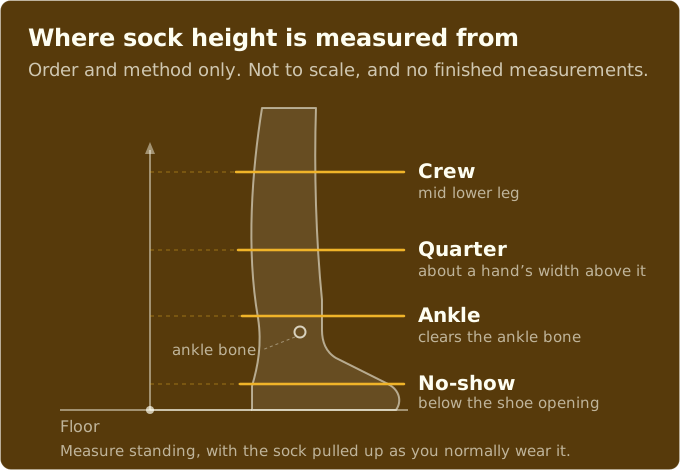
The illustration shows the measuring method and the order of the four heights. It does not state finished measurements for any particular sock.
To build your own reference, put a sock on, stand up, and measure from the floor at the back of your heel to the top of the cuff. Measure standing rather than sitting, because the cuff moves when your ankle flexes. Once you have measured two or three pairs you already own, you have a personal scale that survives any brand's naming.
Two things this exposes quickly. Cuff height often differs between women's and men's versions of the same named length, so a men's size chart will mislead you. And leg length changes where a given height lands, so the same crew sock sits differently on a longer lower leg.
Which sock height goes with which shoe
The sock height that works is the one that clears the shoe's edge, because that edge is where rubbing happens. The table below pairs each common women's shoe with the height that clears it.
| Shoe | Height that works | Why | Watch out for |
|---|---|---|---|
| Ballet flats | No-show | The opening is shallow and cut low across the top of the foot, so anything taller shows. | Shallow shoes are where no-show socks slip most. See the next section. |
| Mary Janes | No-show, or a deliberately visible ankle or quarter sock | The strap draws the eye to the ankle, so a visible sock reads as intentional. | Half-visible is the awkward middle. Commit to hidden or clearly showing. |
| Loafers | No-show, ankle, or a deliberately visible crew | Loafers carry all three, so the choice is a style decision rather than a fit one. | A cuff that peeks by a centimetre or two tends to look accidental. |
| Low-top sneakers | Ankle or quarter | Enough height to keep the collar off your skin without adding visual bulk. | No-show works but sits right at the shoe's edge, where rubbing happens. |
| Chunky or retro sneakers | Quarter or crew | A taller, heavier shoe needs more sock to stay in proportion. | A no-show under a chunky sneaker leaves a bare gap that shortens the leg line. |
| Ankle boots | Crew, or quarter | The boot shaft rubs at exactly the height a shorter sock stops, so take the sock past that point. | A cuff ending inside the boot shaft sets up a rubbed line and a blister. |
| Tall boots | Crew or taller | The same principle, higher up the leg. | Bunching. A sock that slides down inside a boot is worse than one that was too short. |
| Heels and slingbacks | No-show, or sheer or fine-knit visible socks | A visible sock with heels is a deliberate look and needs to read that way. | Thick cotton in a slingback tends to slide at the heel. |
One more variable sits outside the table. With cropped or wide-leg trousers the gap between hem and shoe becomes a design decision, so the sock is either matched to the shoe to lengthen the leg line or contrasted with it on purpose.
Why no-show socks slip off your heel
No-show socks slip for three different reasons, and the fix depends on which one you have: the shoe is too shallow, the heel pocket does not fit your foot, or the cuff elastic has gone. Most advice skips this and recommends whichever silicone technology the brand happens to sell. These three checks separate the causes.
Does it slip in every shoe, or only some? If only some, the shoe is the variable. Ballet flats and low-cut flats hold less of the sock down than a taller-backed shoe does, and the same sock may behave perfectly in a different pair.
Does the sock come off the heel, or slide down at the ankle? Coming off the heel points to a heel pocket that is too shallow or too roomy for your foot, which is a fit problem. Sliding down at the ankle points to cuff elastic that has lost its grip, which is a wear problem, and old socks simply do this.
How much do you have to stretch it to get it on? If the sock needs noticeable stretching over the heel, it is under tension in the wrong direction and will work its way off. A larger size can slip less than a smaller one, which is the opposite of what most people try first.
Silicone grips help with the second and third of those. They cannot fix a shoe that is too shallow for a hidden sock, and no sock can.
What quarter socks are for
Quarter socks sit between ankle and crew, about a hand's width above the ankle bone, and their everyday job is clearing the collar of a low-top sneaker while still leaving a bare stretch of leg visible with cropped trousers. Most guides describe them only in a sports context, which is why the height gets skipped.
If your ankle socks disappear inside your sneakers and your crew socks feel like more sock than the outfit wanted, quarter is the height in between. TipSoxx keeps quarter styles in women's cute everyday socks.
How sock height changes comfort, not just appearance
Sock height changes three physical things: where the cuff presses, how much fabric sits against your skin, and which shoe edge the sock has to clear.
Where the cuff presses. A crew cuff sits on a wider part of the leg than an ankle cuff, so the same elastic tension is spread differently. If crew socks mark your legs and ankle socks do not, that is the mechanism, and why socks leave marks on your legs covers it in full.
How much fabric is against your skin. In a humid Australian summer the difference between a no-show and a crew is a real difference in how warm the foot feels, not only a styling one.
Which edge the sock has to clear. Boots rub at the shaft, sneakers at the collar, flats at the topline. The toe seam is a separate friction point with its own fix, covered in seamless toe socks.
Questions we get asked
What is the difference between quarter socks and ankle socks?
Ankle socks clear the ankle bone; quarter socks sit roughly a hand's width above it. The difference is small on paper and obvious once a shoe is on, because a quarter sock clears a sneaker collar that an ankle sock sits inside.
Is a crew sock the same height on women's and men's socks?
Crew height is not reliably the same across women's and men's socks. The naming is shared, the construction often is not, so measure rather than assume.
What sock length works with cropped or wide-leg trousers?
The length that creates the leg line you want in the gap between hem and shoe. Matching the sock to the shoe lengthens the line; contrasting it makes the sock part of the outfit. Half-visible by accident is the only outcome worth avoiding.
Which sock length is best for an Australian summer?
A lower sock means less fabric and a cooler foot, but also less material between your skin and the shoe. If friction is the problem rather than heat, a quarter sock in breathable cotton often beats a no-show, because the extra height keeps the shoe's edge off your skin.
Why do my no-show socks show?
No-show socks show when the shoe is cut lower than the sock was designed for. Ballet flats and low-cut flats are the usual culprits.
Related guides: height is one of four things that decide fit; why socks don't fit maps every fit problem to its guide. For materials and sock types more broadly, start with how to choose the best everyday socks for women. The two other contact points between a sock and your foot are covered in why socks leave marks on your legs and seamless toe socks. If pattern rather than height is your question, see can you wear fun socks to work.
Shop by height: women's ankle socks, women's cute everyday socks for quarter lengths, and women's crew socks.
Published 2 September 2026 by the TipSoxx team, Australia. This guide describes a measuring method and the order of the four heights. It does not publish finished cuff measurements, because TipSoxx has not yet measured its own range, and a stated gap is more useful than an invented number. This article was drafted with AI assistance, structured by the TipSoxx team, and checked against our current range by the reviewer named below. The diagram illustrates the measuring method and is not a scale drawing.
Reviewed by: Chelsea Ding