

Best Material for Socks: Read the Label First
There is no best material for socks. There is a best fibre for each job a sock does, and almost every sock in our range is a blend of three fibres doing three jobs. Across the 190 women's styles in our own range that publish a composition, 155 are three-fibre knits, 33 use four or five fibres, one uses two, and exactly one is a single fibre, read from TipSoxx product pages on 1 October 2026. "Cotton socks", "merino socks" and "bamboo socks" are all names for the largest fibre in a blend, and the other fibres decide as much about how the sock behaves as the one on the front.
So the useful question is not which material wins but which fibre you want doing the main job, and what the label tells you about the rest. This page answers that for the fibres that appear on sock labels: cotton, merino wool, polyester and nylon, viscose and modal, and the elastane that holds all of them up. It is the entry point to our material guides: the wool pages and the problem-specific guides linked below carry the detail. The counts are from our women's range; the three-job logic is the same for men's socks, but we have not counted those labels.

What are socks made of?
Three jobs, usually three fibres. The base fibre is the one against your skin and the one that handles moisture. The reinforcement fibre carries abrasion at the heel and toe and keeps the sock the shape it was knitted in. The stretch fibre, at a few percent, is the only reason the sock stays up. Here is how those three jobs are filled across our range.
| Job in the sock | Fibres that do it | Found in | Share on the label | Median |
|---|---|---|---|---|
| Base: skin contact and moisture | Cotton | 178 of 190 styles | 20% to 100% | 80% |
| Viscose or modal | 20 of 190 | 21% to 81.2% | 45% | |
| Merino or wool | 13 of 190 | 10% to 60% | 20% | |
| Reinforcement: durability and shape | Polyester, nylon or acrylic, combined | 184 of 190 | 3% to 98.5% | about 16% |
| of which polyester, including recycled polyester (rPET) | 153 of 190 | |||
| of which nylon or polyamide | 39 of 190 | |||
| of which acrylic | 3 of 190 | |||
| Stretch: holding the sock up | Elastane, spandex, Lycra or rubber thread | 188 of 190 | 0.9% to 15% per entry | 3% |
Read from TipSoxx product pages on 1 October 2026. A style can appear in more than one row. Two styles list no stretch fibre; two contain no natural fibre at all; none contains bamboo. One style lists two stretch entries that add to 20%.
The shape of a typical label follows from that table. The most common composition in our range is cotton between 70% and 84%, a polyester or nylon share between about 10% and 30%, and elastane at around 3%: 105 of the 190 styles sit in that cotton band, and 100 of those also carry a 10% to 30% synthetic share. Only one style is 100% cotton, and it says "excluding elastic fibres" on the page; one other, a ribbed slouch sock, lists no stretch fibre and is meant to slouch.
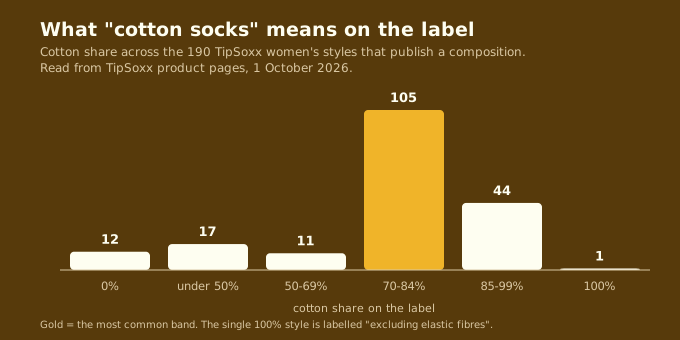
What "cotton socks" means in practice: the cotton share across 190 styles. Read from TipSoxx product pages on 1 October 2026.
How to read a sock composition label
Four steps, in order, and the whole thing takes ten seconds.
- Find the largest number. That is the base fibre and it decides moisture, warmth and feel. On our labels that is cotton 163 times, viscose or modal 15, a synthetic 9 and merino 3, across 190 styles.
- Check the reinforcement share. Polyester or nylon at 10% is a soft sock with a shorter life; at 25% to 30% it is a tougher one. Neither is wrong, but you should know which you are buying.
- Check the stretch fibre. The median on our labels is 3%, and the spread runs from 0.9% to 15% on a single stretch fibre; one style lists two stretch entries that add to 20%. A higher share holds the sock up harder and marks the leg more; what a given percentage does on your leg is explained in why socks leave marks on your legs.
- Treat the name as marketing and the numbers as the product. "Merino" at 20% is, in our range, a synthetic sock with wool in it. "Bamboo" is viscose.
If a brand does not print the percentages, none of the four steps is possible.
What we do not sell, so you do not go looking: single-fibre socks beyond the one 100% cotton style, wool above 60%, bamboo under any name, silk, linen or alpaca, and fully synthetic technical running socks. For the broader question of what makes a sock good for daily wear beyond the fibre, our guide to everyday socks for women covers fit, height and toe construction.

Which sock material is best for which problem?
Pick the problem first; the fibre follows. Each row names the trade-off, because every fibre that is good at one thing is paying for it somewhere else.
| What you are trying to fix | Fibre to put in charge | What it costs you | Where the detail is |
|---|---|---|---|
| Hot, humid days | A cotton-led or viscose-led knit; thin, not thick | Cotton holds sweat and dries slowly, so change socks rather than expect them to dry on the foot | Best socks for hot weather in Australia |
| Cold feet, cold floors | Wool at 47% to 60%, where it is the largest fibre | Price, hand-wash care, and the possibility of prickle | Which merino percentage to choose |
| Sweaty feet that end the day smelling | Wool, for odour; or a synthetic-led knit that dries fast | Wool blends cost more; fast-drying synthetics can feel clammy once saturated | Socks for smelly feet |
| Holes at the heel or toe in weeks | More polyester or nylon, 20% to 30% rather than 10% | A slightly less soft hand-feel | How to make socks last longer |
| Skin that prickles in wool | Cotton-led blends, or low-share merino at 20% or under | Less warmth than a wool-led sock | Is merino wool itchy? |
| White socks that go grey | High cotton, which takes a hot wash | Cotton-rich whites shrink in the first tumble dry, and the elastane goes loose if it is cooked; see do socks shrink in the dryer | How to keep white socks white |
| Socks that will not stay up | Not the base fibre at all: elastane share and height | More elastane holds better and marks more | Why socks don't fit |
The last row is the one no fibre can fix. A sock sliding down is a stretch-fibre and height problem, and switching from cotton to merino will not change it.
What the largest number on the label tells you
The base fibre decides how the sock feels and what it does with sweat, so it is worth knowing what each of the four candidates is like in a sock, and how often each one turns up.
Cotton, the largest fibre in 163 of 190
For most days, cotton is the right base, which is why it appears in 178 of our 190 styles and is the largest fibre in 163 of them. It is soft, it takes a hot wash, and it costs less than wool: our cotton-led socks sit around $14.99 against $18.99 for the wool-led ones, read from TipSoxx product pages on 1 October 2026. What it does badly is dry on the foot, so a cotton sock on a long hot walk ends up damp and stays damp.
Two label details matter more than the word cotton. The first is the share. A sock at 85% cotton and one at 40% cotton with 30% viscose behave differently, and both are sold as cotton socks; our styles run from 20% to 100%, so the number is worth a glance. The second is the reinforcement. A 10% polyester share is a softer sock than a 25% one and, all else equal, a shorter-lived one, which is the trade-off between softness and life described in how to make socks last longer. The cotton-led everyday range is at Women's Everyday Socks.
Viscose and modal, the largest fibre in 15, and why "bamboo" is one of them
Viscose, modal and "bamboo" fabric are the same family: regenerated cellulose, plant material dissolved and spun into a new fibre. Modal is a stronger, higher-wet-strength variant of viscose. "Bamboo" in a sock is almost always viscose made from bamboo pulp, and the US Federal Trade Commission's guidance says there is no trace of the original plant in the finished rayon, that any claim the rayon keeps the plant's antimicrobial properties needs scientific substantiation, and that the fibre should be labelled as rayon or "rayon made from bamboo". That guidance is at the FTC.
We sell no bamboo socks, and we sell 20 styles with viscose or modal at 21% to 81.2% of the knit, read from TipSoxx product pages on 1 October 2026. Regenerated cellulose loses strength when wet, which is why most of them are knitted with 20% to 40% cotton and a nylon or polyester share for structure rather than as viscose alone. If the softness of a "bamboo" sock is what you are after, a modal or viscose-led sock gives you the same fibre under its proper name.

A synthetic, the largest fibre in 9, and merino in 3
Polyester, recycled polyester and nylon appear in 184 of our 190 styles, at 10% to 30% in 145 of them, and a sock without them has nothing carrying the abrasion at the heel and toe: that share is the sock surviving a shoe. In the other 34 the synthetic share is higher, and in nine of those it is 50% or above: the two fuzzy lounge styles, the six 20% merino styles knitted on recycled polyester, and one acrylic-and-nylon floral, where the synthetic is the bulk of the knit rather than its reinforcement. Two of our styles are polyester and nylon with no natural fibre at all: the fuzzy lounge socks. They are warm and soft and they hold almost no moisture, which is fine on a couch and likely to feel clammy inside a boot for a day. If a sock is described as "performance" and its label is mostly polyester, ask what it is performing at; a thin running sock and a thick fluffy sock can have the same label and opposite uses. Our Women's Performance Socks are cotton-led at 54% to 87.8%, read from TipSoxx product pages on 1 October 2026, which tells you they are built for grip and cushioning rather than for fast drying. For running or sport the sock you want is a thin synthetic-led knit built to dry fast; we do not make one, so look elsewhere for that job.
Merino is the base fibre with the best-documented properties, and most "merino socks", ours included, contain less of it than the name suggests. Wool holds the most moisture of the fibres in the chart below at standard humidity, and The Woolmark Company describes it as naturally odour resistant because its keratin proteins bind the molecules that sweat produces; that description is on Woolmark's fibre page. In our merino collection, the wool share runs from 10% to 60%, with a median of 20%, and in 9 of the 12 wool-containing styles wool is not the largest fibre, read from TipSoxx product pages on 1 October 2026. Seven of the 19 styles in that collection contain no wool at all, and no sock page we publish states the fibre's micron, which is the figure that decides whether wool prickles. What the percentage means for warmth is in what the merino blend percentage means; whether it will itch you is in is merino wool itchy. The collection is at Women's Merino Socks, and for the cold months generally there is our winter socks page.
Why do fibres behave so differently with sweat?
Because they hold very different amounts of water. The textile trade measures this as moisture regain: the weight of water a fibre holds in the standard testing atmosphere of 20°C and 65% relative humidity, as a percentage of its dry weight. The commonly tabulated values, here from Textile Calculations, a textile-education site that does not cite the standard it drew them from, are wool 16%, viscose 11%, cotton 8.5%, nylon 4%, acrylic 1.5% and polyester 0.4%. They are textbook figures, and we have not checked them against the ASTM or ISO regain tables ourselves.
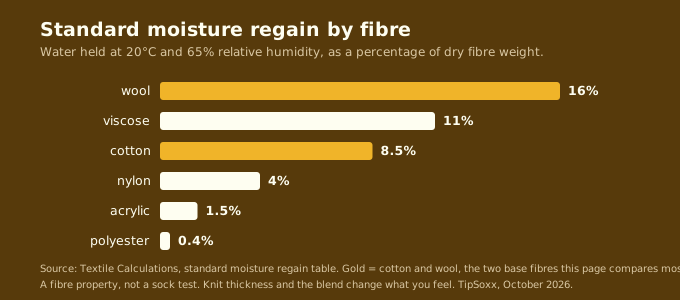
Standard moisture regain at 20°C and 65% relative humidity. Textbook values from Textile Calculations, which cites no standard; chart by TipSoxx. Regain is a conditioned-air figure, not the maximum a fibre can soak up.
Read the chart as a description of what each fibre does with your sweat, not as a ranking. Wool and viscose take moisture into the fibre and hold a lot of it, which is consistent with wool feeling dry for longer on a cool day; what a viscose sock feels like on a foot is not something a regain figure tells you. Cotton takes in a useful amount and then gives it back slowly, which is fine at a desk and the reason cotton has a poor reputation for running. Polyester and nylon take in almost nothing; moisture sits on the fibre surface and either evaporates or stays as a film against your skin, depending on how thick the knit is and how much air moves through it. A thin synthetic knit has little to dry; a thick fluffy one holds water between its fibres whatever they are made of.
Those figures are fibre properties. We have not run moisture or drying tests on our own socks, and a knit's thickness, loop structure and the mix of fibres change the result, so treat them as the direction of the effect rather than a prediction for any one pair.
Questions we get asked
What is the most durable sock material?
The reinforcement share, not the base fibre: no base fibre is durable on its own. Polyester appears in 153 of our 190 styles and nylon in 39, at 10% to 30% in about four styles out of five. Look for 20% or more of either if holes are your complaint.
What is the most breathable material for socks?
As a rule of thumb, a thin knit of any fibre beats a thick knit of a "breathable" one; we have not measured it. Between fibres, the ones that take moisture into themselves, wool, viscose and cotton, feel drier for longer at a desk; the ones that do not, polyester and nylon, dry faster once wet. For an Australian summer the answer is in best socks for hot weather in Australia.
What is the best sock material for sweaty feet?
It depends on whether the problem is wetness or smell. For smell, wool's odour binding is the best-documented property. For wetness through a long day, a thin synthetic-led sock that you can change beats a thick absorbent one. Socks for smelly feet separates the two.
Are cotton or wool socks better?
Cotton for warm days and hot washes; wool for cold days and odour. For skin that has prickled in wool, start cotton-led, though the eczema trials described in is merino wool itchy point the other way for superfine wool. Our range is 178 cotton-containing styles to 13 wool-containing ones, which tells you which of those problems we have built the range around: the everyday range is cotton-led and the merino collection is where the wool is.
Does the material matter more than the fit?
For comfort over a day, fit matters more; for whether your feet are damp or cold, the material does. The fit side is covered in why socks don't fit and the size side in what size socks do I need.
Reviewed by: Chelsea, TipSoxx. Counts cover the 190 women's styles that published a composition on 5 October 2026 and will change as styles come and go; the product page, not this census, is current. No moisture, wear or drying test has been run on these socks.