

Merino Wool Socks in Australia: What the Blend Percentage Means
A sock labelled "merino wool blend" can contain almost any amount of merino. In the TipSoxx range that single phrase currently covers socks at 20% merino, socks at 60% merino, and leg warmers at 10% wool. There is no standard behind the words, so the label tells you a marketing category and the composition tells you the product.
The useful question is therefore not whether to buy merino, but how much merino, for the climate you actually live in. This guide answers both, using our own compositions as the worked example.
How much merino is in a "merino wool blend" sock
Merino content in socks sold under that description ranges from about 10% to about 60% in the TipSoxx range, read from our product pages on 2 September 2026. Six crew styles sit at 20%, one at 47%, one at 57%, one at 60%, and the knit leg warmers at 10% wool.
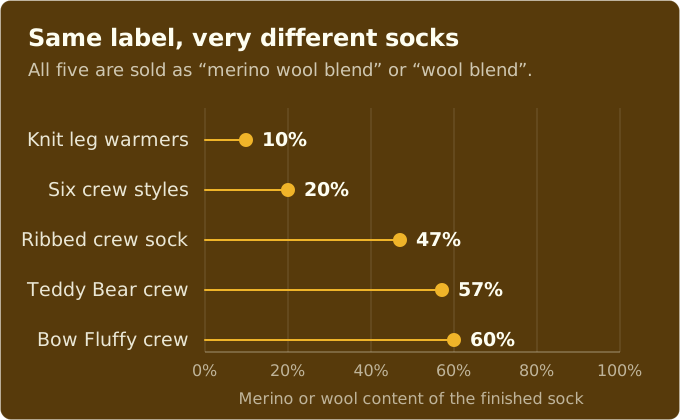
Merino content in TipSoxx styles that all use the same "merino wool blend" or "wool blend" wording. Read from TipSoxx product pages, 2 September 2026.
| Merino content | What that share changes | Where it sits in the TipSoxx range |
|---|---|---|
| 10% | Enough to change the hand-feel of a cotton knit. A product at this level is a cotton product with wool in it rather than a wool product. | Knit leg warmers (70-80% cotton, 10% wool) |
| 20% | The most common level TipSoxx uses. Merino is a supporting fibre: it contributes to feel and warmth while recycled fibres, nylon or acrylic carry the structure. | Six crew styles, including the patterned, puppy, zebra and swan designs |
| 47-57% | Merino becomes the largest fibre by share. A sock in this band behaves like a wool sock rather than a knit with wool in it. | The ribbed crew sock at 47% and the Teddy Bear at 57% |
| 60% | The highest merino share in the TipSoxx range. | One style, the Bow Fluffy crew sock |
Two limits on that table. TipSoxx has not run comparative warmth or moisture testing on these socks, so the descriptions above are about what each fibre share does structurally, not measured performance. And the percentages are the ones published today; check the individual product page rather than this table if you are reading much later.
The transferable rule for shopping anywhere: the phrase on the front tells you the category, the composition on the back tells you the product. A brand that does not publish the percentage has told you something too.
What the other fibres in a wool sock do
The non-wool fibres in a merino blend carry durability, shape and stretch, which is why a sock made only of merino would wear out quickly at the heel and toe. Each of the four common additions does a distinct job.
Nylon, polyester and acrylic carry abrasion resistance and shape retention. In the TipSoxx wool blends these sit at around 20%, and in one vintage floral style acrylic is the single largest component at 45% with merino at 20%.
Recycled fibres appear at 20-57% in several TipSoxx wool-blend styles, doing the structural job that virgin synthetics would otherwise do.
Lycra spandex or elastane at 2-6% is what keeps the sock on your foot. It is also the fibre responsible for the cuff pressure that leaves a ring on your leg, which is a separate subject covered in why socks leave marks on your legs.
Viscose appears in one style at 6% and contributes to the surface softness.
Can you wear merino wool socks in an Australian summer?
Merino socks work better in dry heat than in humid heat. Wool is hygroscopic, which Woolmark describes as the fibre's ability to "absorb and retain liquid moisture, including sweat and moisture vapour". That absorbed moisture still has to evaporate somewhere, and humid air gives it nowhere to go. In a Brisbane or Darwin February the air is already close to saturated, so the same sock has a much harder job than it does in dry inland heat.
That distinction matters more in Australia than the usual summer-versus-winter framing, because most merino sock advice is written for the northern hemisphere and assumes two seasons. Three further Australian-specific points follow from it.
The indoor-outdoor swing is the strongest everyday case for wool. An office at 21°C and a car park at 33°C within the same hour is an ordinary Australian day. A fibre that buffers that swing is doing more useful work than one optimised for a single temperature, and this is where a mid-range blend earns more than either a heavy wool sock or a thin cotton one.
Alpine winter is a different product question. For the snowfields, sock thickness, boot fit and cushioning matter as much as fibre content. TipSoxx merino styles are everyday crew socks rather than technical ski socks, and we would rather say so than let a search term pull us somewhere we do not belong. For general cold-weather choices, our winter socks guide covers the broader range.
Southern-hemisphere timing breaks imported advice. An article telling you to stock up on wool socks "for the season ahead" in October was almost certainly written for a northern winter. In Australia that month is spring.
Which merino percentage to choose
Choose the merino share by how cold you actually get and how much laundry care you will realistically do, not by assuming a higher number is better. The four common cases:
- Everyday wear in a temperate city, mostly indoors. A merino share around 20% gives the hand-feel and some of the warmth without the price or care requirements of a high-wool sock.
- Cold mornings and long days on your feet. The 47-60% band is where merino is doing the main job rather than assisting.
- Humid heat. Consider whether a breathable cotton or cotton-rich sock is the more honest answer for those months. TipSoxx sells both, and the right one is the one that suits the weather.
- Hiking, snow or long-distance running. Buy from a brand that tests for those conditions. TipSoxx does not, and an everyday patterned crew sock is not a substitute.
How to wash merino wool socks
Wash merino socks cool, keep them out of the tumble dryer, and dry them flat where you can. Wool's failure mode is felting and shrinkage from heat and agitation rather than ordinary wear, and the change is irreversible once it happens. The structure behind it is the fibre's outer cuticle, which Woolmark describes as "overlapping scales that sit in a stacked formation like roof shingles". Woolmark's page documents that structure; the laundry consequence above is standard wool care advice rather than a claim from that source.
A sock at 20% merino is more forgiving of a mistake than one at 60%, simply because there is less wool present to felt. If laundry realism is a factor in your household, that is a small practical argument for the lower band.
Questions we get asked
Is a higher merino percentage always better?
A higher merino percentage is not always better. More merino usually means a warmer, softer, more expensive and more care-sensitive sock, so a high percentage in a mild climate is paying for a property you will not use.
Why is there recycled fibre in a merino wool sock?
Recycled fibre in a wool sock does the structural job that nylon or polyester would otherwise do: durability and shape retention. Several TipSoxx wool-blend styles use it at 20% or more.
Are merino wool socks itchy?
Merino fibre is finer than the coarse wool many people remember from childhood jumpers, which is the usual reason it is chosen for socks. Individual tolerance still varies, and a lower-percentage blend is the lower-risk place to start if wool has irritated you before.
How do I find out what percentage I am buying?
Look for a number rather than an adjective on the product page. If a listing says "merino blend" with no composition, ask the retailer before buying. TipSoxx publishes the composition on each product page.
What size are TipSoxx merino socks?
TipSoxx merino crew styles are one size, fitting AU 5-9 and EU 36-40, with a foot length of approximately 22-26 cm.
Related guides: this article sits alongside how to choose the best everyday socks for women, which covers materials and sock types more broadly, and best winter socks in Australia.
Shop the styles described here in merino wool socks, or the everyday cotton alternative in women's crew socks.
Published 2 September 2026 by the TipSoxx team, Australia. Fibre compositions, prices and sizes are read from TipSoxx product pages on that date and may change. This article was drafted with AI assistance and structured by the TipSoxx team; the percentages, product names and range details were checked against our live product pages by the reviewer named below, and the diagram is an illustration built from those percentages rather than a photograph. TipSoxx has not commissioned laboratory testing of these socks, and nothing here reports test results.
Reviewed by: Chelsea Ding