

How to Make Socks Last Longer
Keep them out of the dryer, wash them cool and inside out, and own more pairs than you think you need so each one gets worn less often. Those three do most of the work.
But before any of that, there is a number on the product page that decides how much life the sock had to begin with, and almost nobody reads it. It is the share of the sock that is not cotton or wool.
Why do socks wear out so quickly?
The usual answer is that cotton handles comfort and something else has to handle abrasion. Which fibre does that job, and how much of it is in the sock, is published on the product page and varies far more than the listings let on — a few names hint at it, most do not.
We added it up across the 183 women's styles in our range that publish a full composition, reading from our product pages on 21 September 2026:
| Reinforcement fibre share | Styles | Share of range |
|---|---|---|
| None at all | 6 | 3% |
| Under 10% | 5 | 3% |
| 10–19% | 128 | 70% |
| 20–29% | 10 | 5% |
| 30% or more | 34 | 19% |
The median is 15%, and 128 of the 183 sit in a narrow band between 10% and 19%. That band is the ordinary everyday-sock recipe: cotton for feel, roughly one part in six of something harder-wearing, and a few percent of stretch fibre.
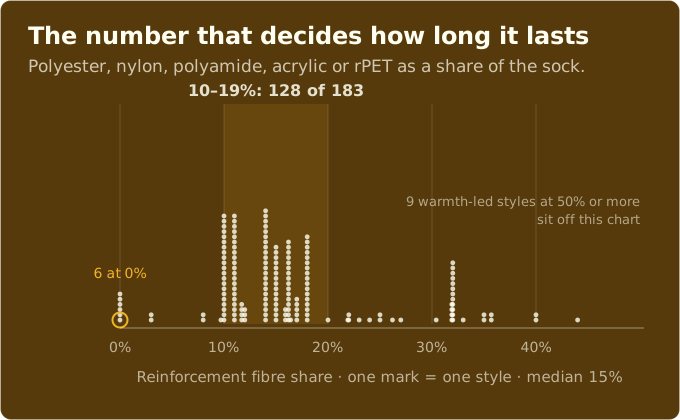
The share of each sock that is polyester, nylon, polyamide, acrylic or recycled fibre (rPET). Read from TipSoxx product pages on 21 September 2026. Each mark is one style; nine warmth-led styles at 50% or more sit off the right of the chart.
The interesting rows are the ends.

Six of our styles publish no reinforcement fibre at all. Two are cotton-and-viscose blends, one is a 100% cotton terry sock, one is a cotton-and-merino novelty pair, one is a knit leg warmer, and one is an argyle crew whose listing says "15% Elastic" without naming a fibre. Read the compositions and these are lovely socks with nothing in the blend doing abrasion work.
One honest caveat on that. Fibre is not the only way a sock is reinforced — a knitted-in heel and toe does the same job, and the terry sock above says exactly that on its own page. So a zero in this column means no reinforcement fibre, not necessarily no reinforcement.
The 30%-plus group is not one thing. Nine of the thirty-four sit at 50% or above, and those are warmth decisions rather than durability ones: two fuzzy styles that are 98% synthetic between them, six merino blends where recycled fibre carries the structure, and one acrylic-and-nylon floral. The other twenty-five sit between 30% and 44% and are mostly everyday cotton and modal crew socks, plus four ankle styles and one wool blend. Above about 50%, this number stops telling you about wear and starts telling you about warmth.
There is no clean pattern by height. The medians run 10.0% on no-show, 14.0% on crew, 16.2% on quarter and 21.9% on ankle, which is not a gradient, and the ankle figure rests on nine styles. We had expected shorter socks to carry more; the data does not support saying so.
What actually ends a sock?
Three things, and only one of them is a hole.
The cuff goes. The stretch fibre stops springing back and the sock will not stay up. Nothing brings it back.
The heel or ball wears through. This is abrasion, and it is where the reinforcement share above earns its keep.
It stops looking like itself. A white sock goes grey, a dark sock pills, a trim flattens. Nothing structural is wrong; you just stop reaching for it.
Only the second of those is a hole, which is why "my socks wear out fast" and "my socks fall down" usually need different answers. If the sock will not stay up, that is a fit and elastane question rather than a durability one: why socks don't fit is the index for it.

How do you make socks last longer?
Five habits, in rough order of how much difference they make.
Skip the dryer. A dryer applies sustained heat and continuous tumbling at once, and those do different kinds of damage. Do socks shrink in the dryer takes that apart properly, including which changes are reversible. Air drying avoids the question.
Wash cool and inside out. The inside takes the wear from your foot and gets cleaner this way, and it keeps trims and embroidery away from zips.
Own more pairs. This is the least fashionable advice and possibly the most effective: a sock worn once a fortnight goes through a fraction of the wash cycles of one worn twice a week. Buying in a pack rather than singly is the cheap way to do it, which is what build a pack and save 20% is for.
Use a mesh bag for anything with lace, sheer panels or a ruffle. A snagged thread on a narrow trim cannot be repaired. The ruffle socks styling guide covers what those trims are made of.
Do not iron a decorative trim. One pass flattens a lace or sheer band permanently.
For wool specifically the failure mode is felting rather than wear, and the care is different again: merino wool socks in Australia goes into what the blend percentage changes.
Why do our own care labels disagree with each other?
They disagree because construction differs, and it is worth showing you the spread rather than pretending there is one rule. Across our 187 women's styles:
| What the label says | Styles saying it |
|---|---|
| Wash cold | 175 |
| Do not bleach | 170 |
| Tumble dry low | 94 |
| Do not tumble dry | 29 |
| Line dry or dry in the shade | 55 |
| Lay flat to dry | 2 |
| Do not iron the print, bow, lace or ruffle | 52 |
| Do not iron at all | 14 |
| No drying instruction of any kind | 9 |
Ninety-four of our styles say a low tumble dry is acceptable and twenty-nine say not to tumble dry at all. Both are correct for the sock they are printed on: a plain cotton crew with no trim has little to damage, while a viscose blend or a lace band does. No listing of ours gives two contradictory drying instructions.
The ironing rows are worth reading carefully, because they are not the same instruction. Fifty-two of our listings say not to iron a specific decorative element and are silent about the rest of the sock; fourteen say not to iron it at all; and one says to iron on low if needed. "Do not iron" on a product page is usually about the trim.
The row we are not happy with is the last one. Nine styles publish no drying instruction at all, which is a gap on our product pages rather than a licence to do as you like. Where a brand publishes nothing, treat the sock as though it were in the do-not-tumble group.
The honest summary: the label on the sock in your hand beats any general rule, including this article.

Is it okay to wear the same socks for three days?
For the sock, the damage is per wash cycle and per hour of wear, so wearing a pair for three days and washing it once is gentler on the sock than three pairs washed three times.
For your feet, it is not the trade we would make. Socks absorb moisture all day, and a damp sock worn again is a different proposition from a fresh one, particularly in an Australian summer. Rotating more pairs gets you the same laundry saving without that.

Are expensive socks worth it?
Price is not the signal; the composition is, and it costs nothing to read. Across our own range the everyday recipe is a reinforcement share around 15% with a few percent of stretch fibre, and you can check any listing against that in a few seconds.
We have not run wear testing on our own socks or anyone else's, so we cannot tell you how many months any of this buys you. What we can tell you is which number to compare, and that the number is published.
Questions we get asked
How do you make socks last longer?
Air dry rather than tumble dry, wash cool and inside out, and rotate more pairs so each gets fewer wash cycles. Before that, buy socks with a stated reinforcement fibre share — across our own range the median is 15% and 128 of 183 styles sit between 10% and 19%.
Why do my socks wear out so quickly?
Check what actually failed first. A cuff that no longer grips is a stretch-fibre problem and a different article; a hole at the heel or ball is abrasion, and the reinforcement fibre share is the number to compare.
Why do socks not last long?
A sock's working life depends on what is blended in alongside the cotton. Six of our own 183 styles that publish a composition list no reinforcement fibre at all, though one of those states a knitted-in reinforced heel and toe instead, which does the same job by construction.
Is it okay to wear the same socks for three days?
It is gentler on the sock than washing three pairs, because damage is per cycle. It is not what we would do for foot comfort, especially in summer. Rotating more pairs achieves the same thing.
Does washing socks inside out actually help?
It puts the surface that takes the wear from your foot where the water and detergent reach it, and it keeps trims and embroidery away from zips in the drum. It costs nothing, which is most of the argument.
Should I throw away socks with holes?
A hole at the heel or ball is abrasion and can be darned if you care to. A cuff that no longer grips cannot be fixed, and that is the one worth replacing.
Related guides: for what happens to socks in the wash, see do socks shrink in the dryer. For wool care specifically, see merino wool socks in Australia. For decorative trims and what they are made of, see how to style ruffle socks. If the problem is that a sock no longer stays up rather than that it has worn through, start at why socks don't fit. For what to look for on any listing, see what makes a sock good for daily wear.
The cheapest way to rotate more pairs is build a pack and save 20%.
Published 26 September 2026 by the TipSoxx team, Australia. Composition and care-label counts are read from TipSoxx product pages on 21 September 2026 and may change; the individual product page is always the current source. "Reinforcement fibre" means polyester, nylon, polyamide, acrylic or a recycled equivalent, added together. TipSoxx has not run wear, abrasion or laundry testing on these socks, and nothing here reports test results.
Reviewed by: Chelsea Ding